
Eric Louviere
Coach for coaches · 2w
Content that fills your pipeline while you coach.
A done-for-you LinkedIn system for executive and leadership coaches:
I extract your frameworks, write posts in your voice, design scroll-stopping visuals, and turn your ideas into an inbound lead engine that compounds month over month.

I'm Vin Agarwal. 15+ years writing professionally, 7+ years in design. I run QuillPixel Studio, where I turn coaches' ideas into LinkedIn authority in their voice, not AI's.
You know LinkedIn is the single best place to build authority as an executive coach in 2026. You know your ideal clients are scrolling it every day. You know your peers are landing inbound calls every week. Some of them have worse coaching skills than you. They just show up consistently. You don't.
You've tried.
So now LinkedIn is a slow guilt loop.
You open the app. Scroll your own feed. See your peers posting. Close the app. Tell yourself you'll figure it out next month.
Meanwhile the pipeline stays where it is.
This is the actual cost. It's not the time. Not the money.
It's the slow, invisible erosion of the authority you've earned over a decade of doing real work, because…
That's the problem I solve. Here's how.
Most ghostwriters take a quick call, then disappear and hand you generic posts with your name slapped on. I work the opposite way.
Before I write a single post, I pull out the raw material that's already in you: your frameworks, your strong opinions, the things you say to clients over and over, the stories you tell, the hills you'll die on.
Got a lot to work with? Newsletters, emails, talks, old posts. Great. The more there is, the faster I find your voice.
If you don't, that's fine too. A handful of old emails, a half-finished doc, and 60 focused minutes on the onboarding call with me is enough to start. I'll do the digging. Your job is just to talk.
Not single posts, but a living pool of ideas, angles, and hooks pulled from your thinking. One framework of yours might become five different posts from five different angles. You think once, I turn it into weeks of content.
Every couple of weeks, fresh post concepts hit the bank. You react: yes, no, not-quite. I write the ones you greenlight in your voice, design the visuals to match, and send for final approval. You approve, I schedule, it goes out.
How involved you stay is up to you.
Some clients riff with me weekly. Some just tap "approve" once a month. Both work. The only non-negotiable is the start, where I need enough of you to make sure everything after sounds like you.
Below is real work for two real clients.
The first is Eric Louviere, a coach who teaches other coaches how to build lean, high-ticket businesses. His voice is blunt, contrarian, zero-fluff: short sentences, hard truths, "I've watched this for 20 years" delivery. The whiteboard visuals and handwritten cards were built to match that energy.
The second is Vyom Mahadevia, a founder building an AI workflow agency for founder-led businesses. Completely different person, completely different voice: grounded, cross-domain, anti-hype, thinks in systems, talks in plain English.
Read the two side by side and notice they don't sound like the same writer, because the writer isn't the point. The client is.
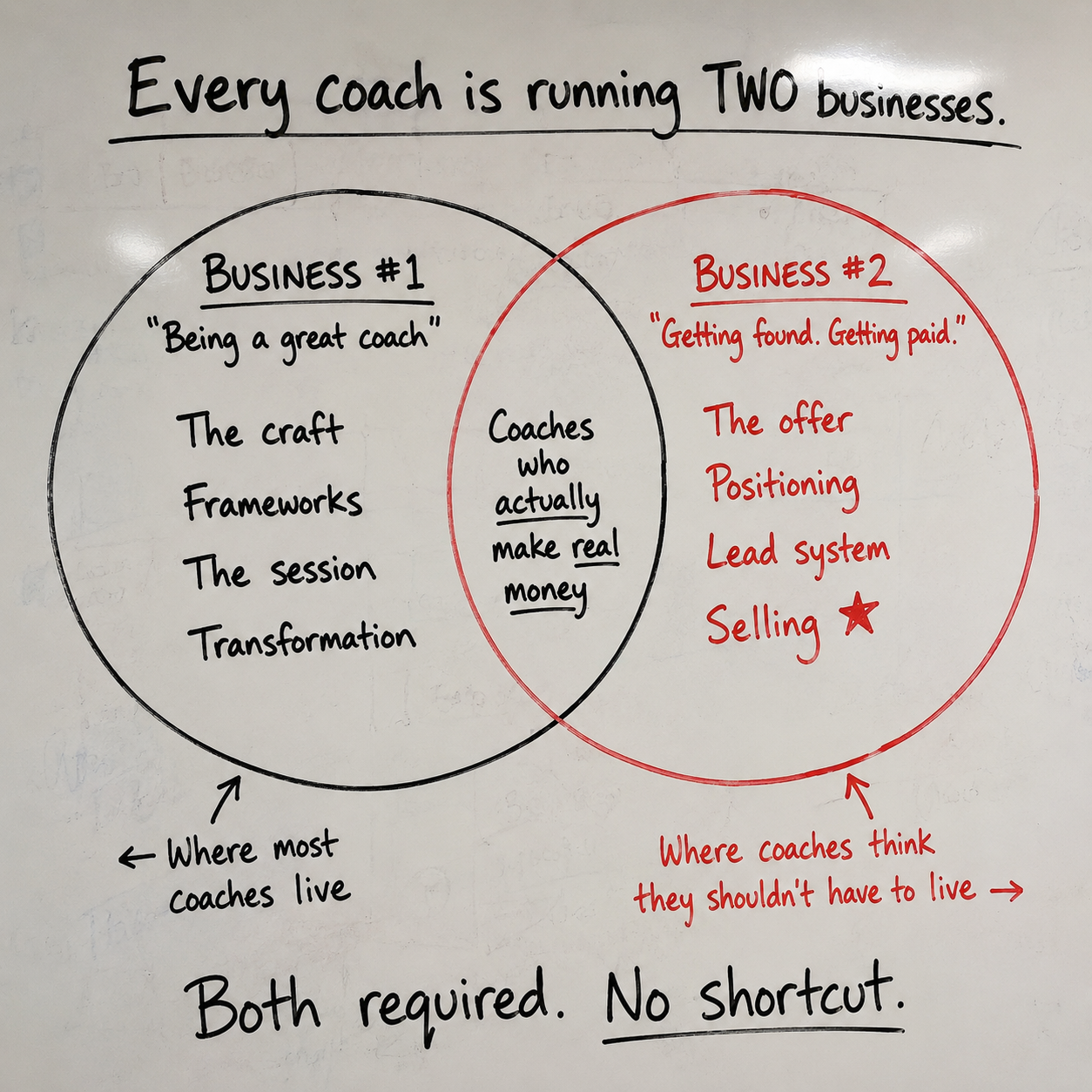
Every coach is running two businesses. Most coaches don't know it. Business #1 is being a great coach. That's the craft. The frameworks. The questions. The transformation that happens in the session. Business #2 is getting found, getting trusted, getting paid. That's the offer. The positioning. The lead system. The sales conversation. Two completely different businesses. Two completely different skill sets. BOTH REQUIRED.
My programmer earned more than me.
I had 30 employees, two offices, was making the company millions. And I was personally broke.
Every week I was pulling a rabbit out of a hat just to make payroll. Hamster wheel grind. Burnt out down to the bone.
I almost got a job. Truth. After 20 years online and tens of millions earned… I genuinely considered going back to a cubicle.
The side coaching business I'd been running on the weekends was making me a fortune compared to the big operation. So I sold the empire.
That was almost a decade ago. Since then:
Here's what I learned the hard way: More clients is not the answer. More employees is not the answer. More overhead is not the answer.
Fewer clients. Higher fees. More net income. More life. That's the whole system.
90% of coaches reading this are building the wrong kind of business. They're not building businesses, they're building stressful jobs they own.
If you're tired of that… DM me. Serious people only.
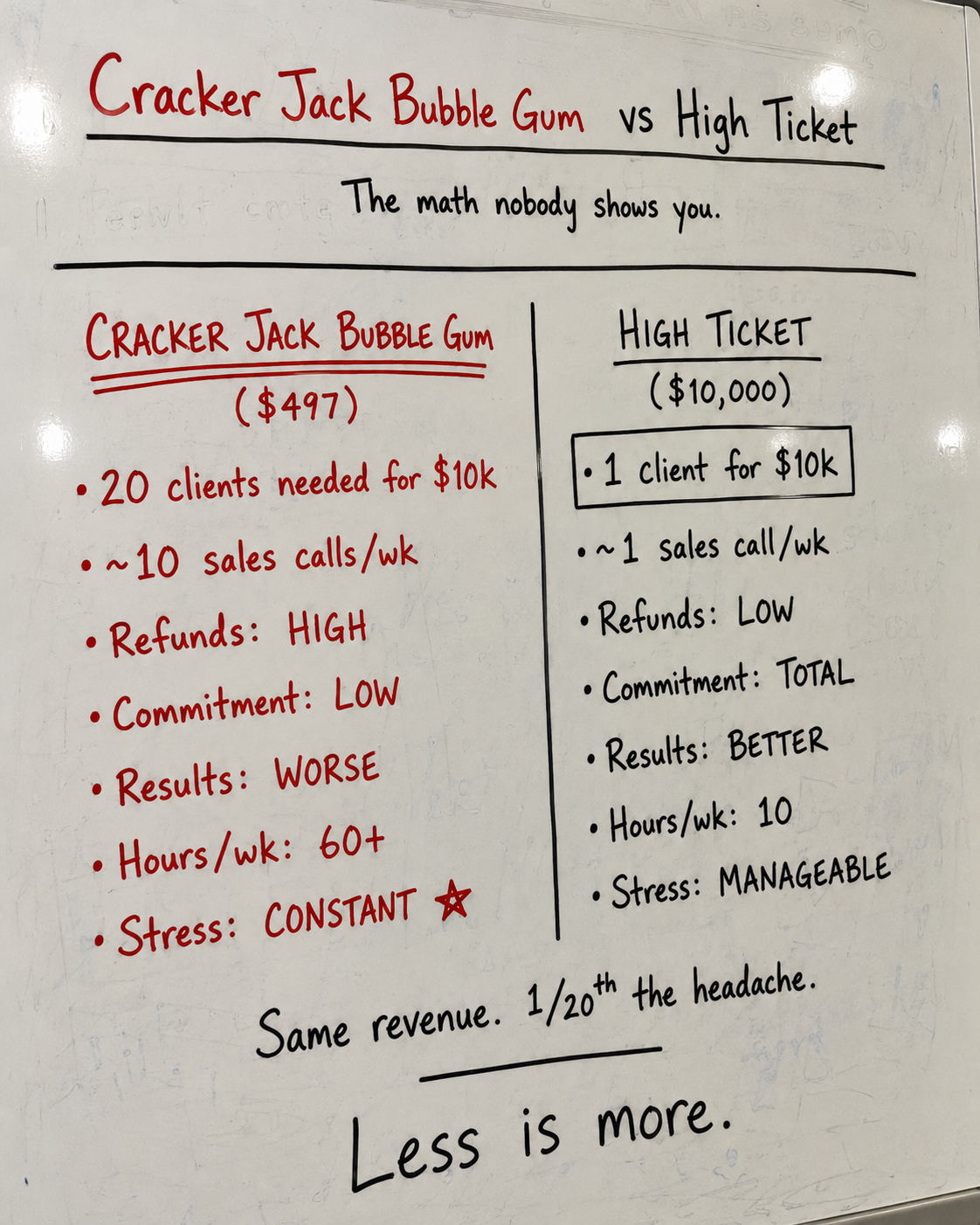
$497 courses. $97 ebooks. $27 PDFs. Done. Unless you have a $50k/month ad budget and a team of 12… low ticket is a slow death. Here's the math. To make $10k in a month at $497 per sale, you need 20 sales. That's 20 customer service requests. 20 refund risks. 20 onboarding sequences. 20 people who paid you peanuts and treat your time like peanuts. To make $10k at $10k per sale? You need ONE client.
Got an email this week that wrecked me.
A guy who'd been at this for 4 years and made nothing.
His words: "I have been learning and tinkering with this online business dream for near 4 years now and am nowhere close to making six figures."
I've heard that sentence 500 times. Different names. Same sentence.
He's not lazy. He's not dumb. He's been WORKING.
Reading the books. Watching the videos. Buying the courses. Listening to the podcasts. Taking the seminars.
And he's nowhere.
You want to know why? Because none of that stuff works.
I have NEVER met a single person who makes six to seven figures online and credits a course for getting them there. Not one. Not a YouTube video. Not an ebook. Not a podcast.
The people who actually make it? They ALL credit a person. A real human being who looked them in the eye and said "do this, not that."
Every time. Without exception. For 20 years now.
If you've been at this 4 years and you're still at zero, the problem is not the market. The problem is not the niche. The problem is not the strategy.
The problem is you've been trying to do it alone with content. And content doesn't get you there. A person does.
I'm not saying that to sell you something. I'm saying it because I've watched it for two decades and the pattern doesn't break.
If you're the guy who emailed me… I see you. And if you're someone reading this thinking "that's me" — DM me. Or don't. Your choice.
But know this: another year is going to pass. And you'll either be in the same spot or you won't.
Many Blessings,
~Eric

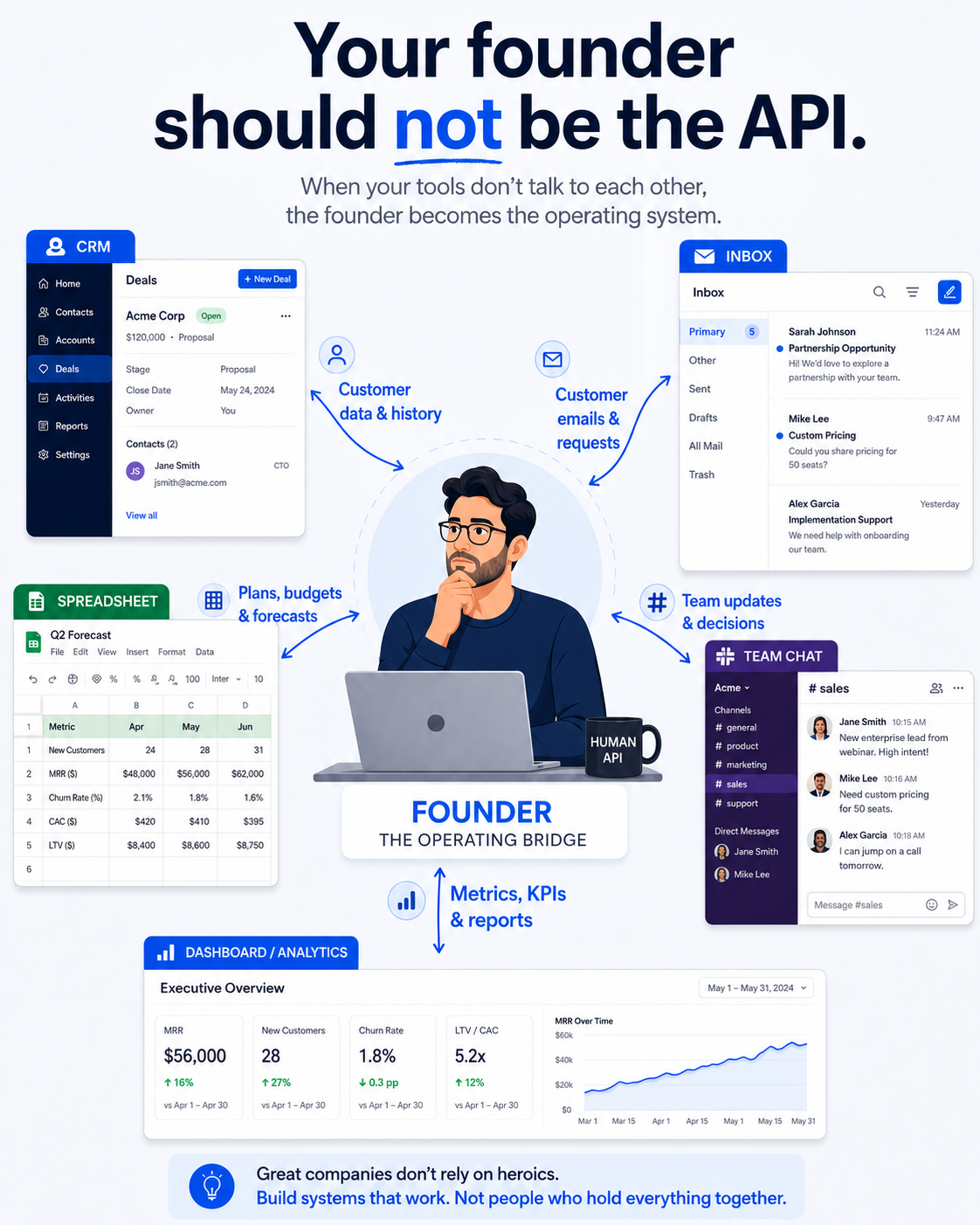
Most founder-led businesses are being run from five open tabs. The CRM. The inbox. A spreadsheet. Slack. And one dashboard nobody fully trusts. Every morning, the founder opens all five and tries to reconstruct what is actually happening. Which leads need following up? Which customers are at risk?
I ran a marketing agency at 22, out of Dubai.
I hated it.
Clients, invoices, cash flow, chasing payments, the servicing treadmill. Constantly being stuck in the middle.
The client would ask for something. I would take it to the delivery team in India. They would send it back. I would take it back to the client.
Whenever something went wrong, I was responsible for the outcome, but I did not understand the work deeply enough to judge it properly myself.
I looked at software and thought: that's the smarter model. Recurring revenue. Sleep well. Build it once, sell it repeatedly. Nothing to deliver twice.
So I spent the next 15 years doing everything except an agency. An ecommerce brand. A decade of trading. Every model I could find that didn't involve fulfillment.
Now I'm building an agency again. On purpose.
Here's what I got wrong at 22:
I thought the agency model was the problem. It wasn't. The problem was I was 22. I was selling something I hadn't built enough judgment to price properly. I was delivering work I hadn't yet learned to systemise. And outsourcing from Dubai to India without really understanding why the arbitrage worked.
The model wasn't bad. I was under-equipped.
Twenty years later, the AI wave has changed the maths. Work that needed a larger team and months of delivery can now be scoped, built and tested in weeks. Fixed price becomes possible. The client can actually own the thing at the end. You're not selling hours, you're selling an outcome that either saves money, saves time, or makes money. If none of those are happening, what's the point?
That's not the agency I hated at 22. That's a completely different business.
It doesn't matter that I was right or wrong then. It just means the same model can be a bad idea in one decade and the right one in another — because the operator has changed, the technology has changed, the economics has changed.
Backtest the model, not the vibe. Right?
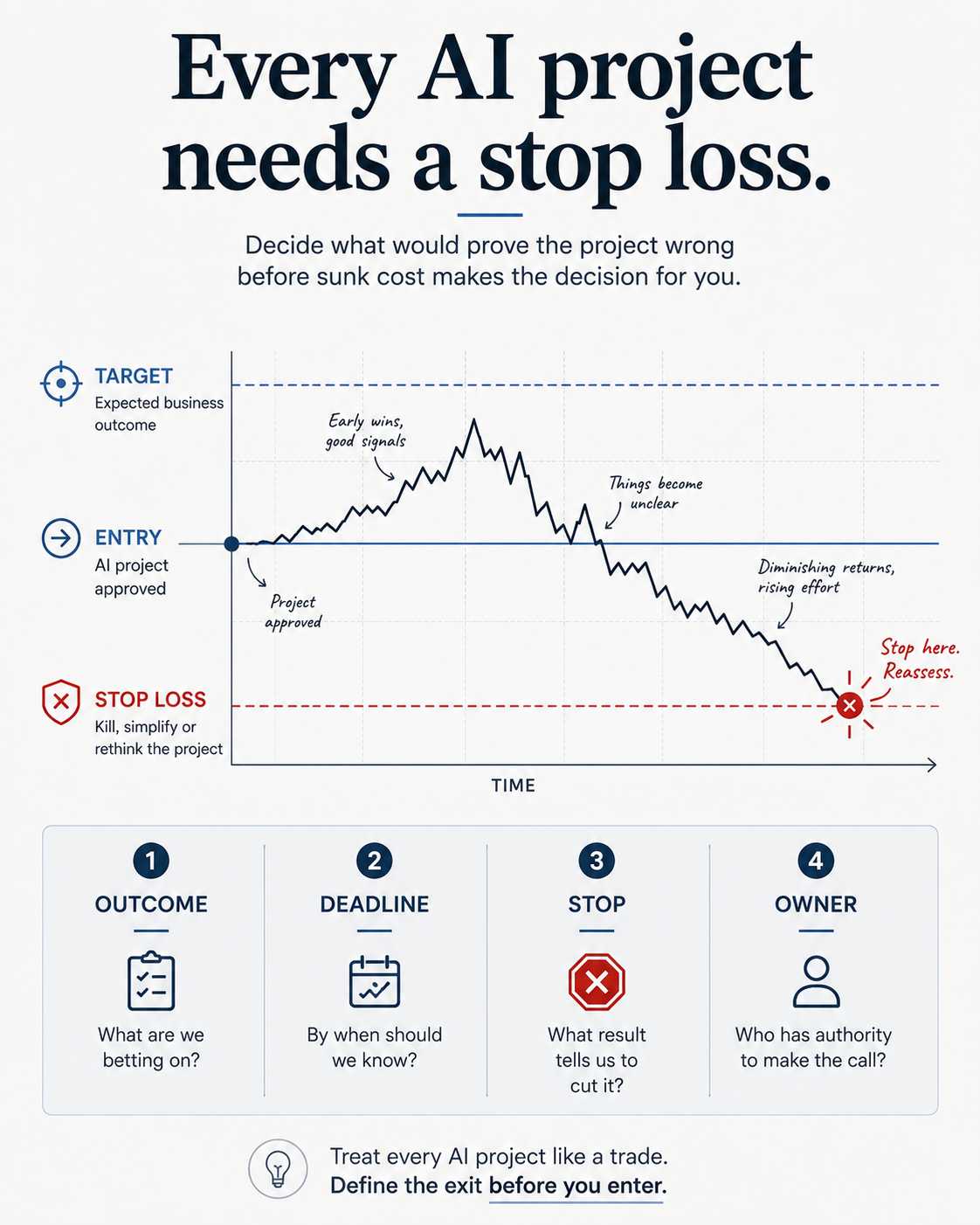
Every AI project needs a stop loss. Most do not have one. In trading, you decide what would prove you wrong before you put the trade on. You know how much you are willing to lose. You know what would make you exit. It is the mechanism that keeps one wrong idea from becoming an expensive one.
That's the whole promise.
I didn't impose a style on either of them. I extracted theirs and amplified it.
When I write for you, it won't sound like Eric. It won't sound like Vyom. It'll sound like you.
A reflective, framework-driven leadership coach gets calm, considered posts. A fiery contrarian gets fire.
Want to see what this would look like in your voice? That's what the call is for.
Not templates. Not recycled hooks. Posts built from your frameworks, stories, and opinions. A mix of authority pieces, personal stories, contrarian takes, and practical frameworks, so your feed reads like a person, not a content calendar.
Infographics, quote cards, diagrams, carousels, designed to match your voice and stop the scroll. These become saveable, shareable assets that keep working long after the post goes out. Seven years of design work goes into making sure they look like they belong to you, not like a template with your name on it.
Every idea, angle, and hook I extract from you goes into a living bank we build over time. Month 3 is easier than month 1. Month 6 is easier than month 3. Your content engine compounds, and that's the point.
You approve, I schedule. You never have to think about "what should I post today" again.
One onboarding deep-dive to start (first month only), then two monthly strategy calls to review what's working, capture fresh ideas from you, and steer the next batch.
You'll rarely need it. But it's there, and it keeps both of us honest and fast.
Comment engagement, DM management, connection outreach, newsletters. I do one thing (authority content that fills your pipeline) and I do it at a depth generalists can't. If you want an agency that does everything at 60% quality, that exists. It's not this.
We start with a recorded onboarding call. I ask the questions that pull out your frameworks, your strong opinions, the advice you give clients over and over. You point me to anything you've already got: emails, old talks, podcast appearances, half-finished docs. Then I go to work building your voice profile and your first content bank. This is the only phase where I need real effort from you.
I send your first batch of post concepts. More than you need, so you choose what feels most you. You react with a quick yes / no / not-quite. I write the approved ones in full, design the visuals, and send them for final approval.
Posts go live on a consistent schedule. Every two weeks, fresh concepts hit your content bank. Two short monthly calls keep the ideas flowing and the strategy sharp. Your involvement from here: as much or as little as you want. Some clients riff with me weekly. Some just approve once a month from their phone. Both work.
The speed depends mostly on you. Coaches who turn around the onboarding material fast have had posts ready in under 10 days.
I want to be completely straight about it, because the difference between what I do and AI slop is the entire reason this works.
What AI slop actually is: someone types "write a LinkedIn post about leadership" into ChatGPT and hits publish. No input, no voice, no real ideas. Just the statistical average of every LinkedIn post ever written. That's why it all sounds the same. That's why you cringed when you tried it.
What I do instead:
The ideas come from you, extracted through real conversations and real material.
The voice comes from you, studied, documented, checked against everything you've ever said.
The editorial judgment comes from me: fifteen years of deciding what's a post and what's filler, what sounds like you on your best day.
AI sits in the middle as a production tool, the way Photoshop sits in a designer's workflow. It makes me faster. It doesn't think for you, and it doesn't speak for you.
The only test that matters: put one of my posts in front of someone who knows you well. If they don't say "yeah, that's them," I've failed, and we fix it.
In today's fast-paced business landscape, leaders must leverage authentic storytelling to unlock exponential growth. Here are 5 key takeaways.
Nobody hires the loudest coach in the room. They hire the one whose thinking they've been quietly reading for six months.
Same subject. Same length. One has an input; the other has a prompt.
Most ghostwriters skim your LinkedIn, absorb a vague impression, and write from that impression. It reads close to you, which is worse than not close at all, because close-but-off is exactly what makes a post feel like someone wearing your name as a costume.
I don't work from an impression. I work from a documented voice profile: your actual phrases, your actual rhythm, the specific way you build to a point versus how someone else would. Every post gets checked against it before it ever reaches you. That's the difference between "sounds like a coach" and "sounds like you."
The test isn't "is this well-written." The test is "would you have said it this way."
That's a higher bar than most writers even attempt. It's the only bar that matters here.
Curious if your voice is one I can capture?
Book a 30-minute call →The ideas are yours. The frameworks are yours. The stories are yours. The opinions are yours. What I add is structure, consistency, and craft, the same way an editor shapes an author's book without becoming its author. Nobody calls a book inauthentic because an editor touched it. And here's the test that settles it: if someone who knows you reads a post and says "that's so them," whose post is it?
Fair question, and honestly, the only real answer is to see it. On the call, I'll walk you through exactly how I'd approach your voice specifically, and you can judge for yourself whether it's something you'd trust.
Most content writers work from a questionnaire and a prayer. I work from a recorded deep-dive, your actual material, and a documented voice profile, and you approve every concept before I write it and every post before it's scheduled. Two checkpoints where bad work gets caught before it costs you anything. Happy to walk through exactly how that would work for your situation on the call.
The onboarding call is the only real time commitment, about an hour. After that, your minimum viable involvement is approving concepts and posts from your phone, maybe 30 minutes a month. More involvement makes the content richer, but the floor is genuinely that low. You spend more time than that deleting spam.
Content compounds, it doesn't spike. LinkedIn's own guidance points to roughly 90 days of consistent posting before reach and inbound really start moving. Anyone promising a full pipeline in week one is selling you a story. What that timeline looks like for your specific situation, and how we'd structure the engagement around it, is exactly what the call is for.
Yes, as a production tool, and I'm completely open about how. Full answer up the page, but the short version: slop is an input problem, not an AI problem. My system exists to fix the inputs: your ideas, your voice, my editorial judgment. AI just makes the production faster.
Straight answer: I'm new to serving executive coaches specifically, and I won't fake social proof. What I can show you: 15+ years of professional writing, the sample work on this page, and a straight conversation on the call about what I can realistically do for you. In six months this section will have case studies. Right now it has honesty.
We talk for 30 minutes. I ask about your practice and your goals; you ask me anything, including the hard questions. If it's a fit, we figure out next steps together, usually within the same week. If it's not a fit, I'll tell you that too. I'm looking for the right five coaches, not the first five.
Not whether to hire me. Not what this costs. Just this:
Is it worth 30 minutes to find out what my ideas sound like when someone finally does them justice?
That's it. The only thing you're risking is half an hour, against the possibility that six months from now, your ideal clients are landing in your inbox because your ideas finally exist where they can see them.
Meanwhile, the cost of doing nothing is already running. Every week you're invisible on LinkedIn, a coach with half your depth is winning clients that should have been yours. Not because they're better. Because they show up.
Five spots, filled with the right five coaches. When they're gone, they're gone.